AI for media buying: what works on Meta and Google Ads
By Matheus Mello, founder of Ads Editor and owner of YEP Agência · Published · 5 min read
AI for media buying works today in three places: reading an account in plain language with its real data, executing tasks from Claude or ChatGPT through MCP, and automating budget changes with hard limits. Strategy, offer and creative are still the media buyer's call, and the useful question is where to draw that line.
Quick answer
In media buying, AI already works on three fronts: analyzing an account in plain language with its real data, executing tasks from Claude or ChatGPT through MCP, and automating budget changes with a ceiling, limited steps and human approval. Strategy, offer and creative remain the media buyer's decisions. Start with read-only questions before delegating actions.
Summary
- AI is good at reading many numbers fast, repetitive tasks described in plain words and 24/7 monitoring.
- It is bad at context outside the data: a sale closed in chat, stock running out, brand positioning.
- An account-aware copilot answers with the client's numbers, not with theory.
- MCP lets Claude, ChatGPT, Codex or Cursor read and change campaigns; in our data, 76% of calls are reads.
- Budget automation needs a ceiling, limited steps, stop-loss and approval for structural changes.
What does AI do well and badly in media buying?
| Does well | Does badly |
|---|---|
| Reading many numbers quickly and pointing out what changed | Knowing what the client sold in chat if nobody told it |
| Executing a repetitive task described in plain language | Deciding the offer and the brand's positioning |
| Watching metrics 24 hours a day | Understanding context that is not in the data, like stock running out |
| Suggesting headlines and keywords for review | Guaranteeing generated copy does not echo a competitor |
1. Copilot: plain-language analysis with the account's data
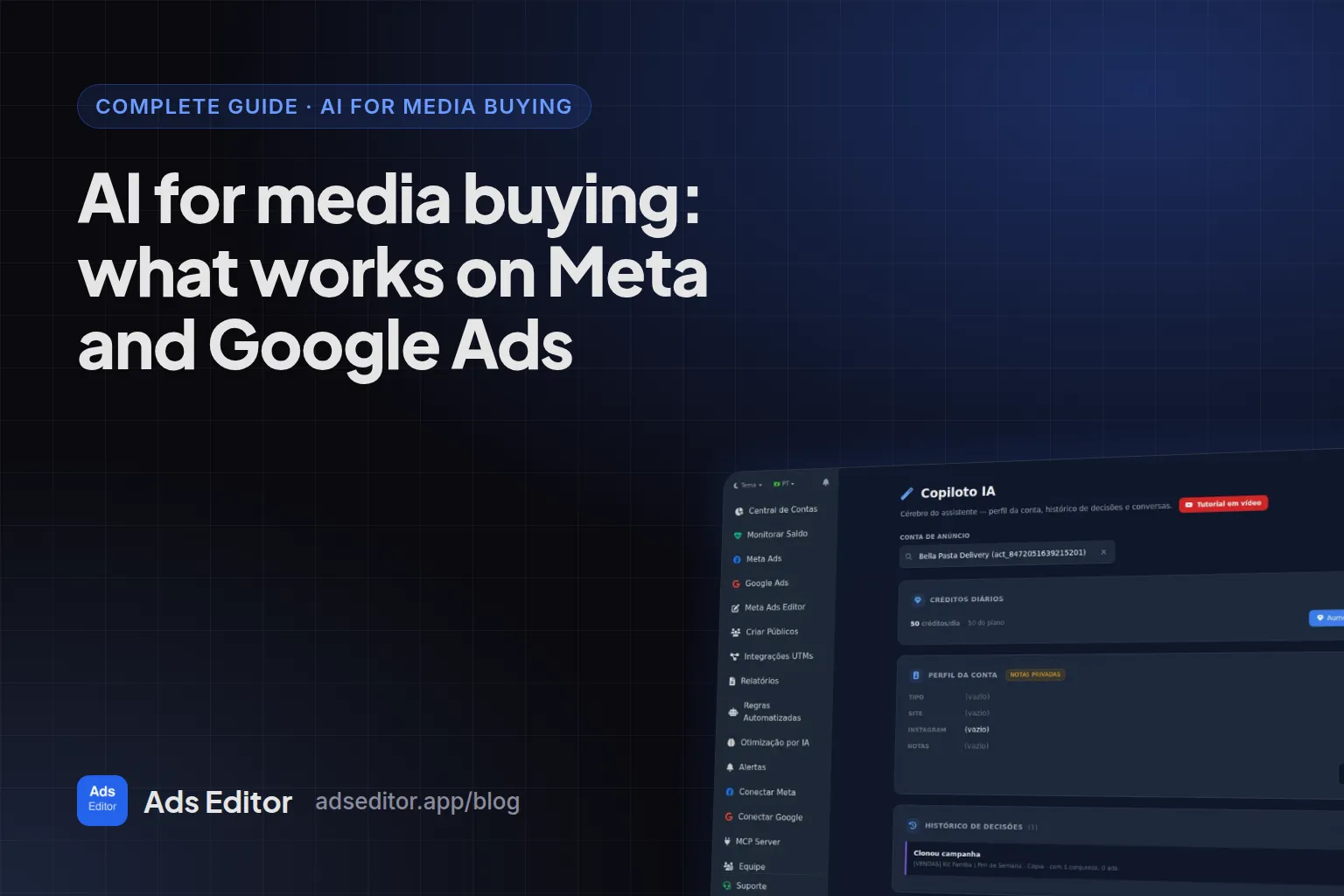
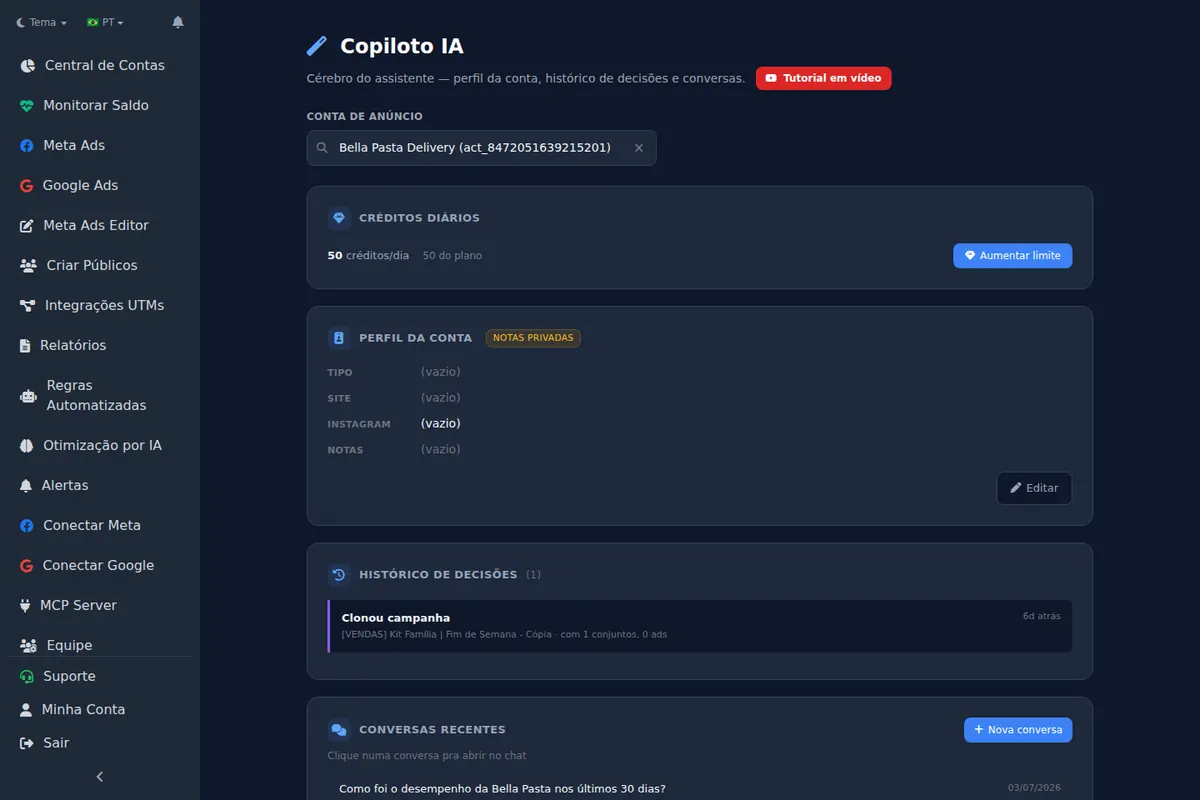
The Ads Editor AI Copilot is a chat inside the manager. The difference from a generic chat is that it fetches the account data on its own: period totals, campaigns and top ads, from Meta through the Facebook API and from Google through the Google Ads API. A question like why did CPA go up this week gets answered with the account's numbers, not with theory.
It also executes actions, always with confirmation in the conversation, and it has protection against malicious instructions hidden in third-party data (prompt injection).
2. MCP: running ads from Claude and ChatGPT
MCP (Model Context Protocol) is an open source standard for connecting AI applications to external systems. The Ads Editor MCP server exposes 212 Meta Ads and Google Ads tools (counted in the code on September 23, 2026): listing and editing campaigns, adjusting budgets, creating rules, reading sales by UTM, building reports and uploading media. Meta launched its own ads AI connectors in open beta on April 29, 2026, and Google published a read-only open source MCP server in October 2025.
The setup guide, including how it compares with Meta's official connector, is in Meta Ads MCP for Claude and ChatGPT, and what users actually do with it is in Meta Ads MCP usage data: 54,267 tool calls by 22 user accounts, mostly to read metrics.
3. Budget automation with safeguards
Automation without safeguards is what gives AI a bad name in ad accounts. Ads Editor AI Optimization scales and cuts budgets with a daily ceiling, steps of up to 35% per re-evaluation, pacing through the day and a stop-loss that halts scaling if results worsen for consecutive days. Structural changes, such as switching ABO to CBO, are only suggested: the switch waits for approval. The scaling logic is in how to scale Facebook ads.
Our position on AI touching budget
If budget automation makes you nervous, do not turn it on. The Copilot and the MCP only act when you ask. Scale by hand, in steps of up to 35%, and turn automation on for one campaign only once you trust the condition.
How do you start with AI without risking a client account?
- Start with read-only questions in the Copilot or over MCP: what changed this week, which ad is tiring.
- Move to repetitive tasks with confirmation: pausing ads with low CTR, renaming in bulk.
- Only then test budget automation on one campaign, on the conservative profile, with a ceiling set.
Can ChatGPT or Claude run Facebook ads on their own?
They can execute what you ask through an MCP server, and some setups let them act without a human in the loop. We do not recommend that for client money. What the data shows is that people use AI mostly as an analyst: in the Ads Editor MCP, the 13 read tools at the top of the ranking account for 76% of calls, and the two action tools among the 15 most used account for under 5%.
What should AI not decide?
- The offer. Price, bonus and guarantee are business decisions with consequences outside the ad account.
- The creative concept. AI can suggest headlines; knowing what the audience has seen too often comes from the market, not the dashboard.
- Structure changes on a live account. Switching budget structure restarts learning; a human should approve it.
- Anything that touches compliance. Health, finance and other regulated niches need a person accountable for what runs.
Frequently asked questions
Will AI replace media buyers?
No. It replaces the repetitive part: forms, monitoring and reading numbers. Strategy, offer and creative stay with the media buyer.
What is the best AI for Facebook ads?
One that sees the account's real data and acts only with confirmation. A chat without account access gives generic advice; connected by MCP or through a copilot, it answers with the client's numbers.
Does the Copilot use my real account data?
Yes. It fetches totals, campaigns and top ads of the selected account, on Meta and on Google.
Can AI change my budget without me knowing?
In the Copilot and the MCP, actions are requested by you. In AI Optimization, only on the campaigns you put in it, with a ceiling, limited steps and a log of every action.
Glossary
- Copilot
- An AI chat inside the ad manager that reads the selected account's data before answering.
- MCP
- Model Context Protocol, the open standard that lets AI assistants call external tools.
- Prompt injection
- Malicious instructions hidden in data an AI reads, meant to hijack its actions.
- AI Optimization
- The Ads Editor feature that scales and cuts budgets automatically within set limits.
References
- What is the Model Context Protocol (MCP)?. Supports: MCP is an open-source standard for connecting AI applications to external systems.
- Meta ads AI connectors (Meta for Business). Supports: Announcement of April 29, 2026: connectors in open beta that let advertisers and agencies create, manage and analyze campaigns directly in the AI tools they already use.
- Open Source Google Ads API MCP Server (Google Ads Developer Blog). Supports: Released October 7, 2025; the initial release is read-only, for reporting and diagnostics, and does not make changes to the account.
Links opened and checked when the article was last updated.
About the author
Matheus Mello, founder of Ads Editor and owner of YEP Agência. Runs client ad accounts at YEP Agência and built Ads Editor so his own agency could stop publishing ads one at a time. Usage numbers quoted on the blog come from the product activity log. Instagram: @theusm