Facebook ads creative testing: structure and cut rules
By Matheus Mello, founder of Ads Editor and owner of YEP Agência · Published · 7 min read
Facebook ads creative testing answers one question at a time: which opening stops the scroll, which promise holds, which format converts. The structure below keeps the answer readable, and it separates the fast decision (cutting losers) from the slow one (crowning a winner).
Quick answer
To test creatives on Meta, use an ABO campaign, 3 to 5 variations per round, about 2x your target CPA per ad set per day and a first read at 48 to 72 hours. Cut what falls below your hook rate, hold rate and CTR thresholds. The winner scales in a separate campaign, never inside the test.
Summary
- Test one variable at a time; mixing audience and creative variables produces results nobody can explain.
- ABO for testing: CBO pours budget into whatever looks good in the first hours.
- One creative per ad set gives the cleanest read; several per ad set is cheaper but uneven.
- Cut after 48 to 72 hours; declaring a winner needs more days and conversion volume.
- Publish every variation in one batch, paused, then activate together.
What does a creative test decide, and what does it not?
A creative test answers one question at a time: which opening stops the thumb, which promise holds, which format converts. It does not answer which audience is best or which bid to use. Mixing an audience variable with a creative variable in the same test gives you a result nobody can explain.
It also helps to separate two decisions the market tends to merge. Cutting the loser is fast: a creative nobody watches after thousands of impressions will not get better. Crowning the winner is slow: it needs conversion volume. The thresholds below are for the first decision; the second needs patience.
ABO or CBO for creative testing?
ABO. With the budget on the ad set, each variation gets the budget you set and the comparison is fair. In CBO, Meta concentrates budget on whatever performs best in the first hours, and the test becomes a self-fulfilling prophecy: the variation that got budget early looks best because it was the only one that ran. Details and the cost of switching a running campaign are in CBO vs ABO.
How many creatives per ad set?
In our operation, a concept test carries 3 to 5 creative variations per round. There are two ways to build it, and the choice is cost against clean reading:
| Setup | What it looks like | Advantage | Cost |
|---|---|---|---|
| One creative per ad set | 3 to 5 identical ad sets, each with one variation | Clean read: each variation has guaranteed budget | Higher total budget: every ad set needs its own |
| Several variations in one ad set | One ad set with 3 to 5 ads | Cheaper and faster to build | Meta distributes delivery unevenly and may barely show a variation |
Rule of thumb: if the budget allows, one creative per ad set. If it does not, several in one ad set, knowing that a variation with few impressions did not lose. It was not tested.
How much budget does each test ad set need?
The Ads Editor threshold is about 2x target CPA per day, per ad set. Below that, the ad set rarely produces a conversion a day and the read stays in the dark. If the total budget cannot fit 2x CPA in every ad set, cut the number of variations in the round instead of squeezing all of them.
That budget reads creative signal; it does not take the ad set out of learning. The math to exit learning is different and lives in Facebook ads learning phase budget.
How long should you wait before deciding?
To cut, 48 to 72 hours. That is the window in which delivery settles after launch. A creative past that window with hook and CTR on the floor can go.
To declare a winner, wait longer: a real winner needs more days of delivery and conversion volume in each variant. Small accounts rarely get there, and that is fine: the provisional winner goes to scaling with a contained budget and keeps being watched.
Which metrics decide the cut?
| Metric | Good | Watch | Critical: candidate to cut |
|---|---|---|---|
| Hook rate (3 s views / impressions) | 30% or more | 20% to 30% | Below 20% |
| Hold rate (15 s views / 3 s views) | 40% or more | 25% to 40% | Below 25% |
| CTR | Stable or above the account average | Dropping against last week | Below 0.5% with enough impressions |
These thresholds are operating alarms, not a market study. Market references for hook, for example, tend to sit at 20 to 25%, below our good. Use them as a starting point and adjust to your account's history. Formulas and the diagnosis for each drop are in hook rate and hold rate.
Bad hook or bad hold: what do you remake?
- Hook below threshold: the opening does not stop the thumb. Redo the first seconds, keep the body.
- Hold below threshold: it opened and did not deliver. Keep the hook, redo the development or make the offer clearer.
- CTR below 0.5% with good hook and hold: the video holds attention but does not lead to the click. Review the call to action, the offer and the button.
How do you publish all test variations at once?
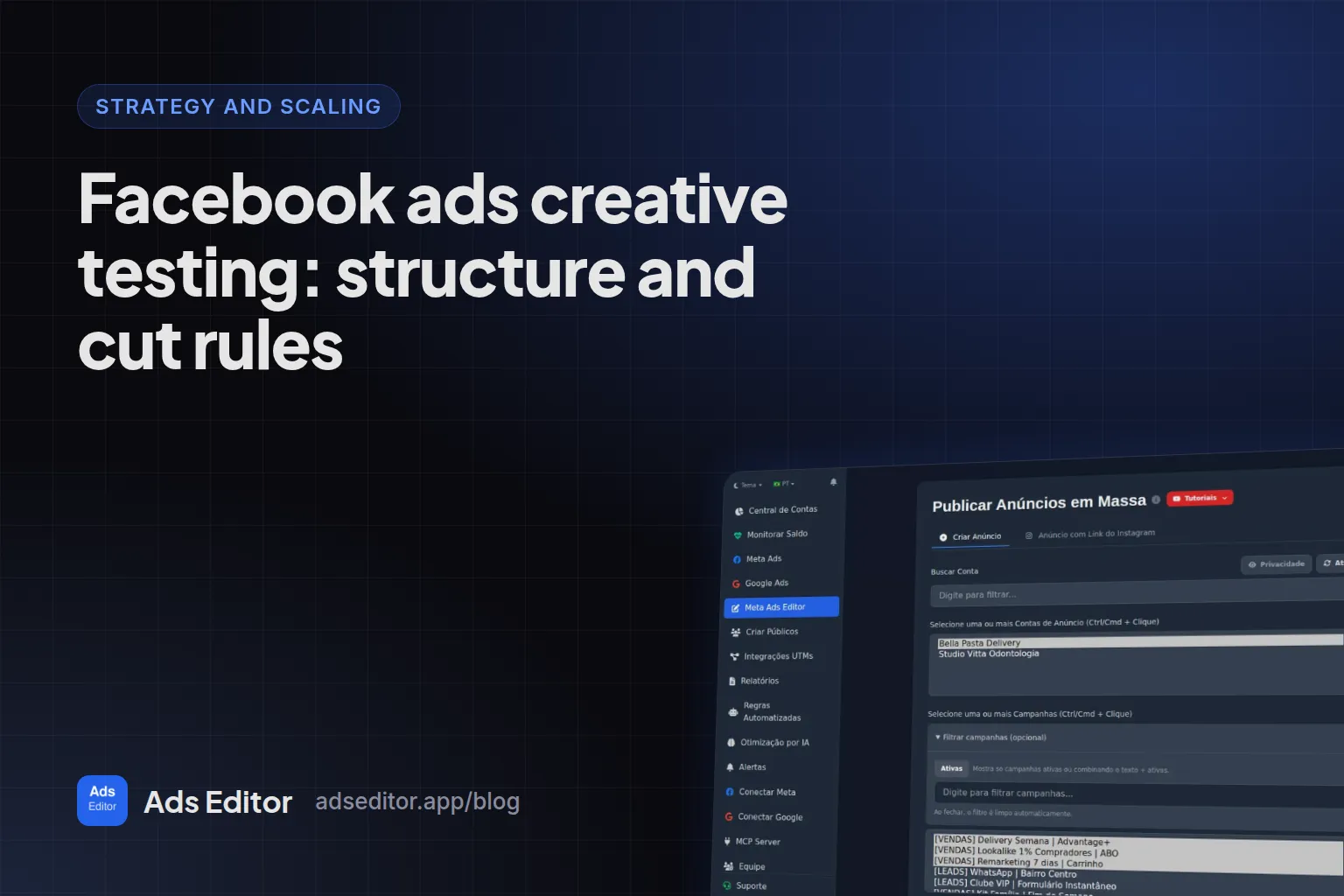
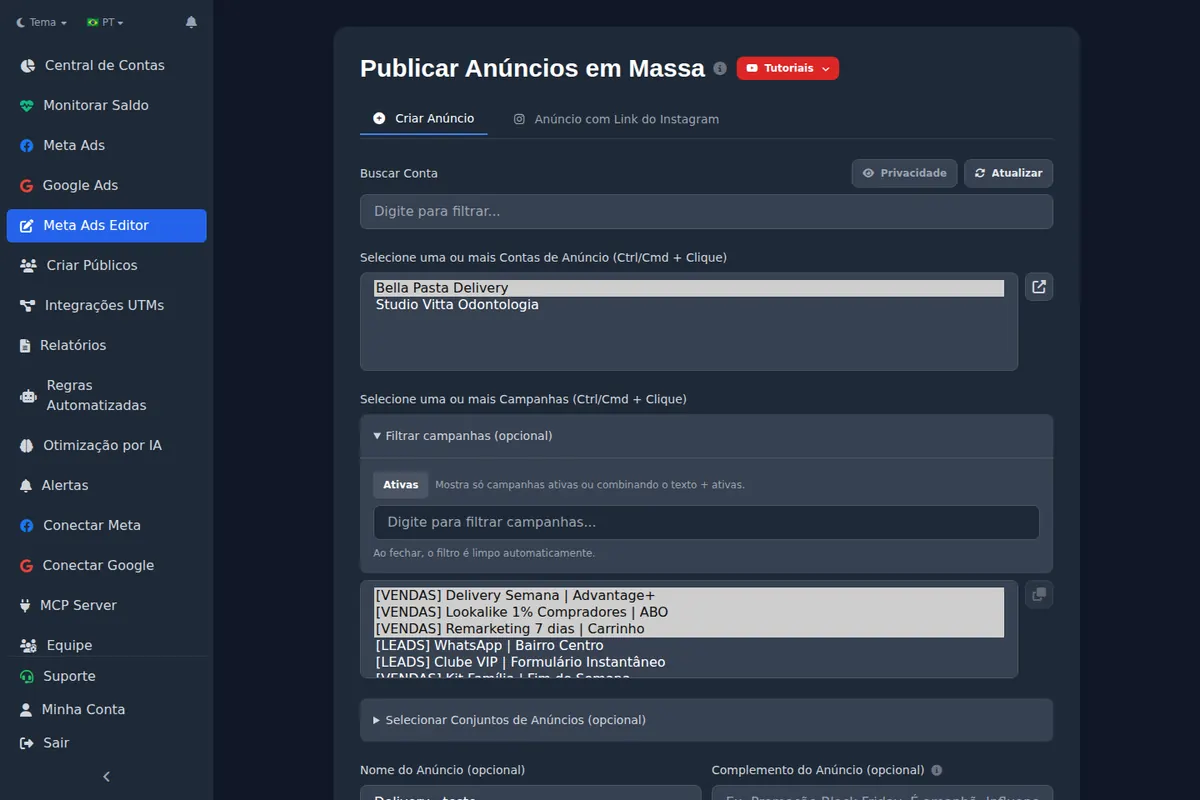
In Ads Manager, every variation is a form. In Ads Editor, the whole test goes out in one action through bulk publishing:
- Create (or copy) the test campaign in ABO, with ad sets already at the threshold budget.
- In bulk publishing, pick the account, the campaign and the test ad sets.
- Drag every variation at once. Text, headline, URL and UTMs are set once for the batch.
- Use the ad name to mark the tested variable (opening A, opening B), so the read in the report is immediate.
- Publish paused, check one ad in Ads Manager and activate them all together, so every variation starts at the same moment.
How does an automated rule pause the loser?
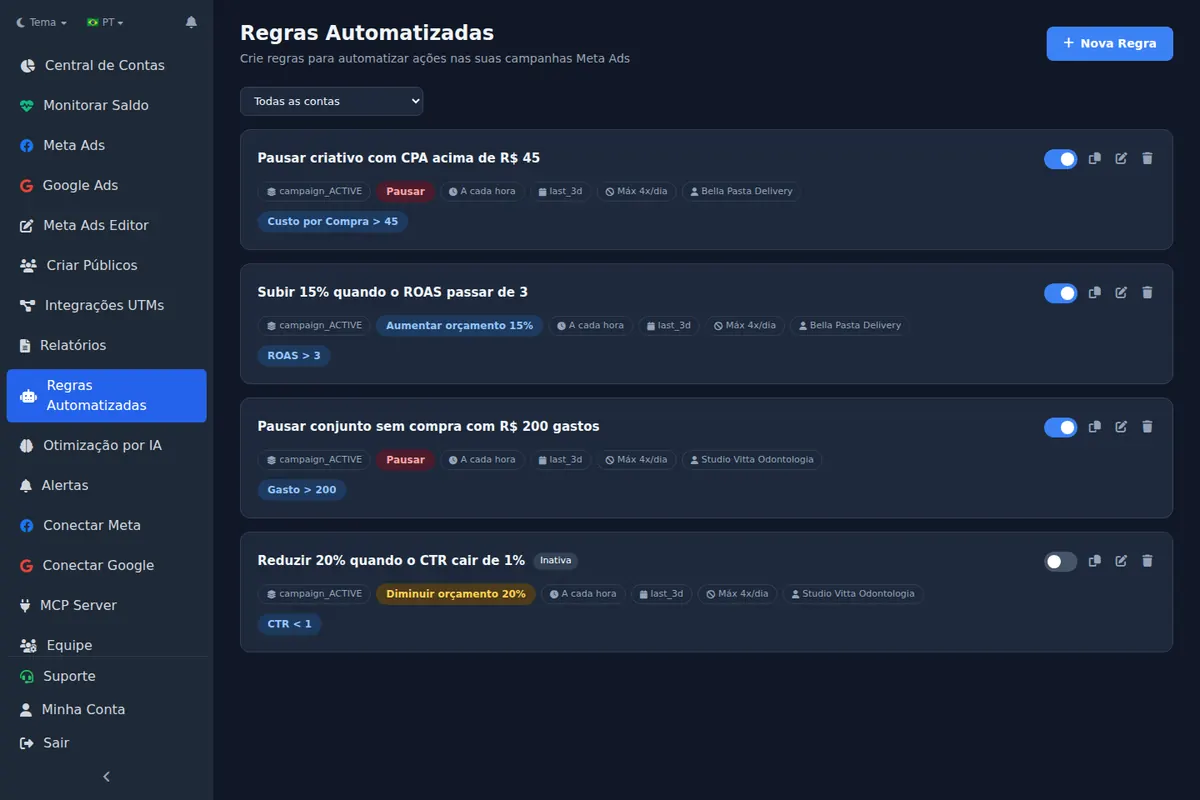
With the threshold written down, the cut becomes a rule. In Ads Editor, build a rule at ad level, scoped by the test campaign's name:
- Condition: CTR below 0.5% and a minimum impressions count that makes sense for your account. Without the minimum, the rule pauses whatever had one bad hour.
- Date range: pick one that includes today and covers the 48 to 72 hour window.
- Action: start with Notify only. When the rule stops producing false positives, switch it to Pause.
Hook and hold rate are not rule conditions; they are tracked by the creative fatigue alert on the Business plan.
What do you do with the winner?
Do not scale inside the test campaign: raising budget there changes the comparison itself. Move the winner into a scaling campaign, in CBO if there is conversion volume for it, and keep testing the next round in the test campaign. The path is in how to scale Facebook ads.
If the question is letting Meta combine copy and media on its own instead of testing variation by variation, that is a different format with a different read: see Meta flexible ad format.
Frequently asked questions
How do you test creatives on Facebook ads?
An ABO campaign, 3 to 5 variations per round, about 2x target CPA per day in each ad set and a first read at 48 to 72 hours, cutting whatever falls below the hook, hold and CTR thresholds.
How many creatives should go in each test ad set?
One per ad set gives the cleanest read. If the budget does not allow it, 3 to 5 in the same ad set, knowing Meta will deliver them unevenly.
How long should a creative run before I pause it?
48 to 72 hours to cut a clear loser. To declare a winner, wait for more days of delivery and more conversions in each variant.
Does creative testing work in CBO?
Worse: CBO concentrates budget on what looks best in the first hours, and the other variations barely run. For testing, use ABO.
Glossary
- Creative test
- A controlled comparison of ad creatives where only one variable changes between variations.
- Variation
- One version of a creative that differs from the others in a single element, such as the opening.
- Winner
- The variation that keeps the best cost per result with enough conversion volume to trust it.
References
- Flexible Ad Format: Why I Use It and How You Can Too (Jon Loomer). Supports: States that Flexible Ad Format is not meant for split testing and that Meta's breakdown by image or video does not work with it, so you cannot tell which creative version performed best.
Links opened and checked when the article was last updated.
About the author
Matheus Mello, founder of Ads Editor and owner of YEP Agência. Runs client ad accounts at YEP Agência and built Ads Editor so his own agency could stop publishing ads one at a time. Usage numbers quoted on the blog come from the product activity log. Instagram: @theusm