Is Ads Editor legit? How the client account is protected
By Matheus Mello, founder of Ads Editor and owner of YEP Agência · Published · Updated · 7 min read
Is Ads Editor legit? We invest in the maximum security we can, always looking for intruders, and every week we keep working to improve that protection. Your account login and the client's ad connection are different things, and each one has a limit. The Facebook password is typed only on facebook.com, and the token does not go to the browser.
Connect my accountsQuick answer
Ads Editor is legit. We invest in the maximum security we can, always looking for intruders. Every week we keep working to improve that protection. The Facebook password is typed on facebook.com, and the Google one on Google's screen. The token stays on the server with AES-256 and does not reach the browser.
Summary
- Ads Editor is secure. We invest in the maximum security we can, we look for intruders, and every week we improve that protection.
- Account login and the ad connection are different things. Social login without an email the provider has confirmed does not sign in.
- The Facebook password is typed only on facebook.com. The Google password, on Google's screen. We do not have access to that password. Connecting does not turn on a rule or scaling.
- The Meta token and the Google token stay on the server with AES-256. The screen only shows connected or not. The token does not go to the browser.
- Team members sign in with their own email and password. If no account is marked, the person reaches every account the owner connected.
- To raise security, turn on two-factor authentication on the Meta account that manages the ads and in Ads Editor, under My Account.
In this article · 8 sections
Login and connection are two different things
Signing in to Ads Editor identifies the person. That account password is separate from the Facebook password. Connecting ads is another authorization. It allows action on the Meta or Google account.
Social login uses Google, Facebook, or Apple, when Apple is configured. It only signs in with an email the provider has confirmed. Without a confirmed email, it does not sign in.
Where the password is typed
Connecting Meta opens Facebook's window. Connecting Google opens Google's window. The Facebook password is typed only on facebook.com. The Google password is typed on Google's screen. We do not have access to that password. No legitimate tool asks for that password in its own form, on WhatsApp, or by email.
What the connection authorizes
The Meta connection authorizes ads, business, Page list and engagement, Page ads, basic Instagram and Instagram results, catalog, and email. The Google connection authorizes the Google Ads permission.
The ads permissions went through Meta App Review. An app that asks for advanced access goes through business verification.
Connecting does not turn on a rule or scaling. A rule and scaling run only if the person configured them.
You can revoke it on Facebook, under Settings, Apps and websites. On Google, the path is third-party app access. Changing the Facebook password drops the connection. The person connects again.
Where the token stays
The Meta token and the Google token stay on the server with AES-256. The screen only shows connected or not. The token does not go to the browser.
The server uses the token for the action the person asks for. It also uses it for the rule or scaling that person configured. On disconnect, Ads Editor stops using that authorization.
Password, sessions, and 2FA
The Ads Editor account password is stored only as a bcrypt hash, outside the profile the screen receives.
Changing the password ends the other open sessions and the remembered login. Remembered login lasts up to 60 days. That is not a Meta token deadline.
To raise the client's security, turn on two-factor authentication in both places. On the Meta account that manages the ads, the path is Accounts Center, under Password and security. In Ads Editor, each person turns on their own under My Account, with an authenticator app or a code by email, and keeps the recovery codes.
Team
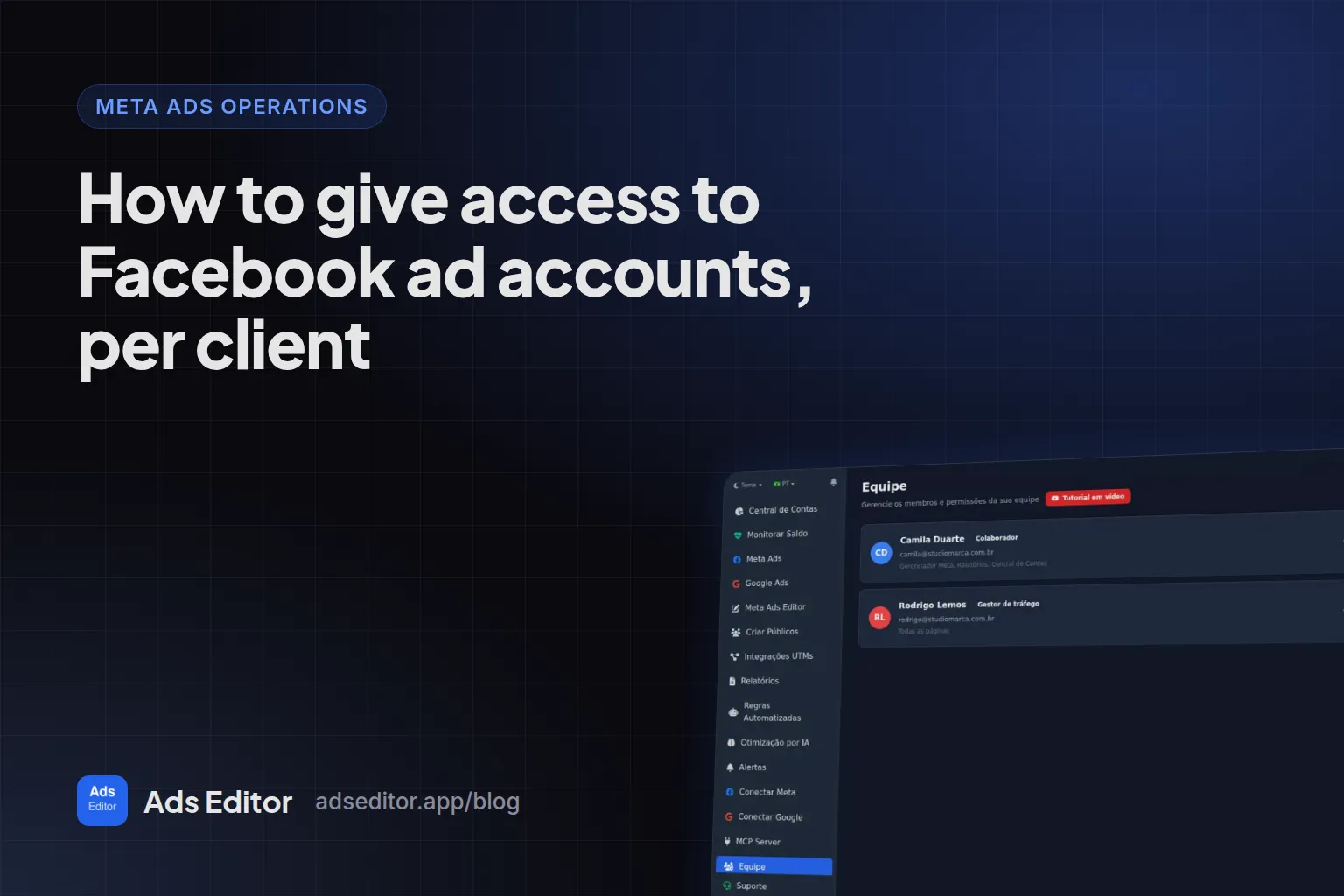
Each team member signs in with their own email and password. The action uses the owner's connection on the server. The token does not go to the member's browser.
Screens and accounts are marked in Team. If no account is marked, the person reaches every account the owner connected. To limit that reach, mark the accounts. Access by account is in give the team access by ad account.
Payment, lists, and Copilot
The card number does not stay in Ads Editor. Billing goes through Stripe. We do not have access to that number.
On a customer list, email, phone, and name go to Meta as a SHA-256 hash. The field Meta requires without a hash follows Meta's rule. The list serves the audience the person asked for.
In Copilot, the question and the context of your own accounts go to the model for that answer. Another Ads Editor customer's accounts do not enter that answer. A note stays on the account where it was saved.
A report with a public link: whoever has the link sees that report. You can set a password. Another Ads Editor customer does not open this account's campaigns, lists, or conversations.
A request that tries to read a secret file on the server is blocked at once. It stays blocked until the Ads Editor team removes the block.
Ads Editor is secure. We invest in the maximum security we can, always looking for intruders. Every week we keep working to improve that protection. The site uses TLS 1.2 or higher. The data privacy article is in privacy and security of ad account data.
What to check before you connect
- The connect window is Facebook's or Google's, and the password is typed on that screen.
- The Ads Editor screen shows only connected or not. The token does not go to the browser.
- Two-factor authentication is on for the Meta account that manages the ads and in Ads Editor, under My Account.
- In Team, with no account marked, the person reaches every account the owner connected.
Who is behind it
Ads Editor was created by Matheus Mello, of YEP Agência, so the agency would stop publishing ads one by one. More on who built it: About.
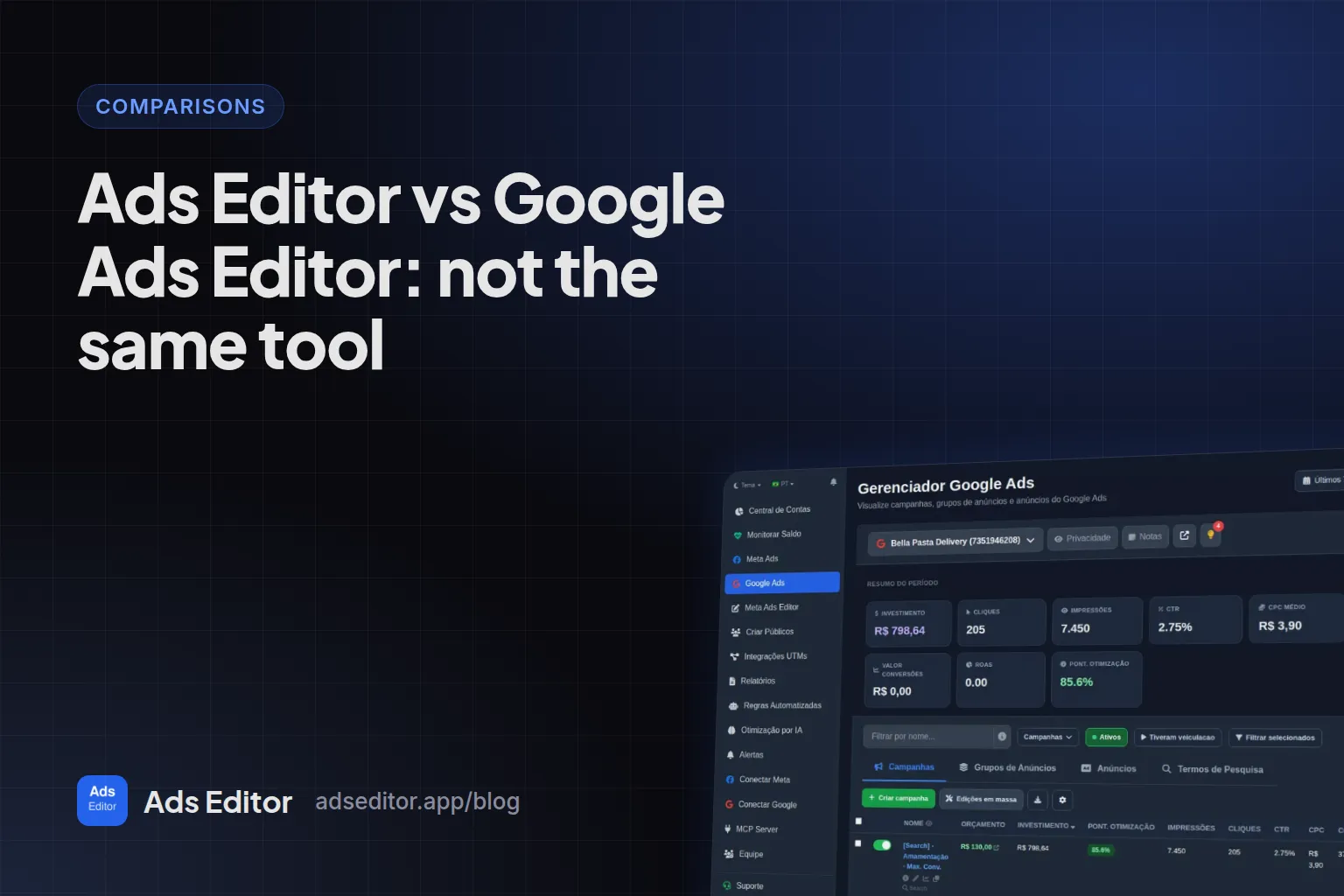
It is not a Meta or Google product, and it is not Google Ads Editor. The difference is in Ads Editor and Google Ads Editor. There is an iPhone app on the App Store, named Ads Editor, published by Matheus Mello.
Step by step in Ads Editor
Help Center articles that walk through this task screen by screen:
Frequently asked questions
Does Ads Editor ask for the client's Facebook password?
No. Connecting Meta opens Facebook's window. The password is typed only on facebook.com. The Google password is typed on Google's screen. We do not have access to that password. No legitimate tool asks for that password in its own form, on WhatsApp, or by email.
Does the token go to the browser?
No. The Meta token and the Google token stay on the server with AES-256. The screen only shows connected or not. The server uses the token for the action asked for and for the rule or scaling that was configured. On a team, the token does not go to the member's browser either.
If no account is marked, is the member locked out?
No. If no account is marked in Team, the person reaches every account the owner connected. To limit that, mark the screens and the accounts. The person signs in with their own email and password, and the action uses the owner's connection.
Does connecting an account turn on a rule or scaling?
No. Connecting does not turn on a rule or scaling. That runs only if the person configured it. On disconnect, Ads Editor stops using that authorization.
Can another customer see this account's campaigns?
No. Another Ads Editor customer does not open this account's campaigns, lists, or conversations. A report with a public link is different: whoever has the link sees that report, and you can set a password.
Glossary
- OAuth
- An authorization where the person signs in on Facebook's or Google's screen. Ads Editor receives permission to act and does not receive the password.
- Access token
- The credential for that permission. It stays on the server with AES-256. The screen only shows connected or not, and the token does not go to the browser.
- Remembered login
- The Ads Editor account login kept for up to 60 days. Changing the password ends that login and the other sessions. It is not a Meta token deadline.
- 2FA
- A second proof of identity. On Meta, it is in Accounts Center, under Password and security, on the account that manages the ads. In Ads Editor, it is under My Account, with an authenticator app or a code by email, plus recovery codes.
References
- Ads Editor privacy policy, version 2.1, 25 August 2026. Supports: The token stays protected on the server and the card number does not stay in Ads Editor.
- Permissions Reference (Meta for Developers). Supports: Ads permissions go through App Review. An app that asks for advanced access goes through business verification.
The claim supported by each source is shown above.
About the author
Matheus Mello, founder of Ads Editor and owner of YEP Agência. Runs client ad accounts at YEP Agência and built Ads Editor so his own agency could stop publishing ads one at a time. Usage numbers quoted on the blog come from the product activity log. Instagram: @theusm